
Bianca Vogel · 13 October 2026
The Dynamics of Endorsement Flows in Local Marketplaces Following Comprehensive Web Infrastructure Changes
Local marketplaces depend on endorsement flows that connect small businesses to customers through reviews, citations, and recommendations spread across regional websites and platforms. Comprehensive web infrastructure changes such as server migrations, content delivery network upgrades, and platform architecture overhauls alter how these endorsements travel and accumulate. Researchers tracking these patterns note that shifts often begin within weeks of implementation and continue for months as indexing systems reprocess the updated structures.
Core Mechanisms Behind Endorsement Movement
Endorsement flows operate through interconnected signals that include backlinks from local directories, mentions on community forums, and aggregated review data from neighborhood sites. When infrastructure changes occur, search engines and aggregation tools must re-crawl and re-evaluate these pathways, which can compress or expand visibility depending on how the new architecture handles redirects and canonical signals. Data from regional economic reports indicate that marketplaces in mid-sized cities experience measurable redistribution within the first quarter after such updates.
Those who monitor local business networks find that endorsement velocity slows initially because new infrastructure requires time to establish trust signals with external crawlers. Yet the same changes frequently improve long-term distribution once caching layers stabilize and internal linking hierarchies become clearer to indexing systems. Observers note this pattern repeated across multiple North American and European marketplaces during 2025 infrastructure rollouts.
Regional Patterns Observed Through 2026
By October 2026, tracking studies from government economic agencies showed distinct geographic variations in how endorsement flows responded to infrastructure modernization. In Australian regional centers, citation networks tightened around government-supported business portals that had undergone simultaneous upgrades, concentrating endorsements among fewer but higher-authority domains. Canadian analysts documented parallel movements where provincial marketplace platforms absorbed redistributed links from smaller municipal sites.
European Commission reports on digital market integration highlight that cross-border endorsement patterns strengthened when infrastructure changes aligned with updated data-sharing standards, allowing endorsements to flow more readily between adjacent national marketplaces. These adjustments occurred without direct intervention, driven instead by the technical compatibility introduced during the infrastructure transitions themselves.
Technical Factors Influencing Redistribution
Redirect chains, sitemap updates, and schema markup consistency play measurable roles in determining whether endorsements persist or fragment after infrastructure work. Local businesses that maintained consistent structured data across old and new environments retained higher percentages of incoming endorsements according to aggregated analytics from industry monitoring services. In contrast, sites that introduced multiple redirect layers saw temporary drops in endorsement transmission as crawlers prioritized shorter paths.
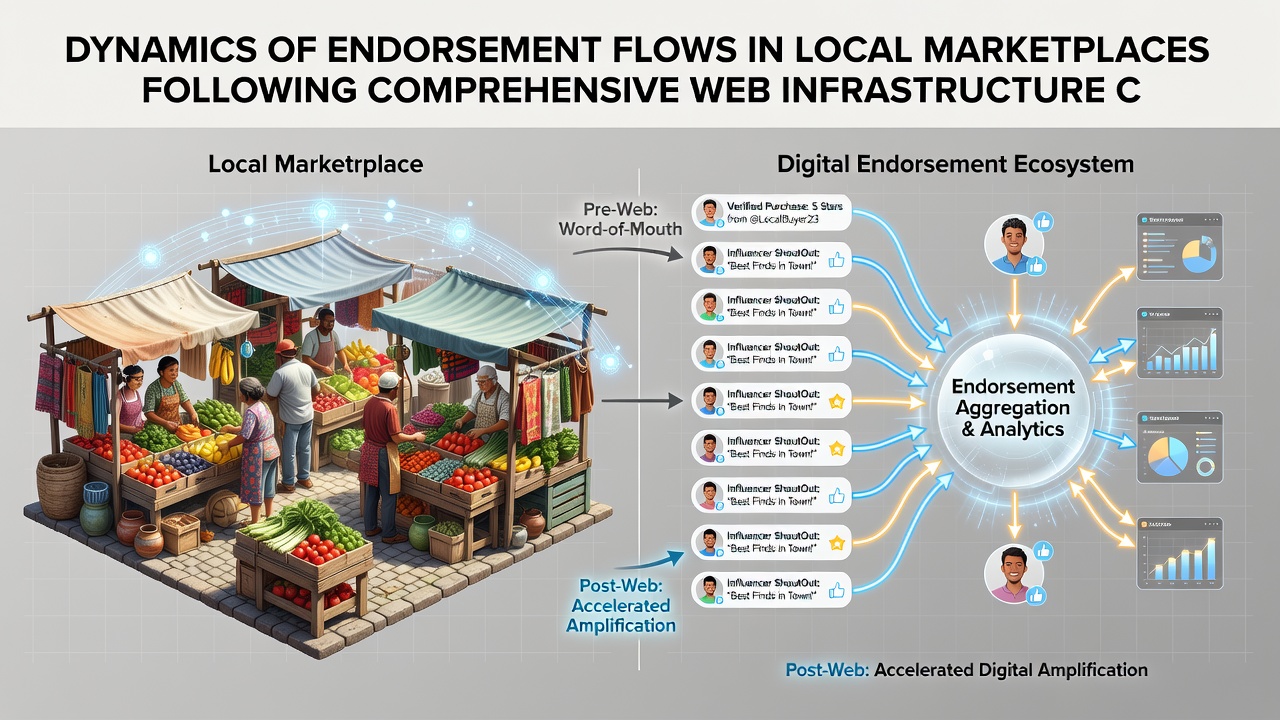
Platform-level changes also affect how third-party endorsement sources interact with marketplace content. When content delivery networks expand geographic coverage, endorsements originating from distant regional sites gain faster indexing, which redistributes influence away from purely local sources toward broader networks. Studies conducted by academic research groups in 2025 and 2026 confirmed this effect through controlled comparisons of marketplaces before and after network expansions.
Business Adaptation and Measurement Approaches
Local marketplace operators have adopted systematic monitoring of endorsement sources using tools that track domain-level citation changes over rolling quarterly periods. These methods reveal that infrastructure changes frequently create temporary windows where new endorsement sources emerge from previously under-indexed community sites and regional blogs. Businesses that update their own internal linking structures to match the new infrastructure maintain steadier flows during these transition periods.
Figures released by the U.S. Small Business Administration in late 2025 demonstrated that marketplaces incorporating regular endorsement audits recovered citation volume faster than those relying on passive monitoring alone. Similar findings appear in reports from European Commission digital market analyses, which examined how infrastructure alignment influences endorsement concentration across member states.
Conclusion
Endorsement flows in local marketplaces respond predictably to comprehensive web infrastructure changes through measurable phases of initial compression followed by redistribution. Technical elements such as redirect management, schema consistency, and network coverage determine the speed and direction of these shifts. Regional data collected through 2026 confirm that marketplaces with proactive monitoring and alignment strategies experience more stable transitions, while patterns continue to evolve alongside ongoing platform developments worldwide.